
Cass County Bench Warrants Explained
A bench warrant is court process that grows out of a required appearance or an order, and in Cass County the underlying case might sit anywhere in the local system. It could be before the Fifth Judicial District Court, the County Court at Law, one of four JP courts, or a municipal court. Whichever court is named on the paper is the authority on what process actually exists there. A missed date does not produce one fixed result. Depending on the situation, the court may issue a summons, an FTA report, a capias, a capias pro fine, a reset, or a warrant. Assume nothing about a missed traffic date; ask the clerk what the docket shows instead, because every case takes its own path.
Cass County Bench Warrant After a Missed Date
A notice in the mail, a ticket in hand, or a relative's phone call is usually the first sign of a missed hearing. Write down the court, the citation or cause number, and the date right away. Then call and ask three things. Is the case still open? Did any process issue? Has another setting been scheduled? A jail custody search cannot answer those questions. The Cass County sheriff's Citizen Connect link tracks confinement, not court status. For real answers on a bench warrant, contact the JP or municipal clerk named on your paperwork, or reach the District Clerk when the case belongs to the district court or the County Court at Law.
How Cass County Bench Warrants Are Issued
Judges issue bench process for several reasons. A missed appearance, a failure to comply, contempt, an unpaid judgment, or a bond forfeiture can all trigger it in Cass County, and the exact response depends on the case. The court's own record will name the process, give its date, identify the case, and state whatever step comes next. When the process is a capias pro fine, Texas Code of Criminal Procedure Article 43.05 governs both issuance and recall. Ask the court whether a hearing is available or which payment route it allows. State rules set no single Cass County payment or recall procedure, so the answer always comes from the issuing court.
Bench Warrants and Arrest Warrants Compared
These labels describe different legal steps, even in Cass County. A bench warrant targets court compliance. An arrest warrant authorizes arrest after a probable-cause process. A capias is Texas process that brings a defendant before the court, while a capias pro fine deals with an unsatisfied judgment or fine.
| Process | Typical trigger | First call |
|---|---|---|
| Bench warrant | Missed setting or court order | Court that set the date |
| Arrest warrant | Probable-cause complaint or affidavit | Issuing court; sheriff for service or custody routing |
| Capias pro fine | Unsatisfied fine judgment | Court that entered the judgment |
A clerk can tell you which label a particular Cass County record carries, and that label shapes whether a reset, hearing, bond, or payment is on the table.
Cass County Bench Warrant Payment Warning From JP3
JP3's own notice carries a blunt warning for anyone paying online. The application may not display every unpaid case, payments can take at least three business days to post, and handing over money does not stop an outstanding arrest warrant from being enforced in the meantime. The court also tells payers to keep the receipt. JP3 serves the Queen City area, but the warning applies only to that court's payment route, not to any countywide rule in Cass County. Before you send a dollar, ask the issuing court how the transaction affects the process and when the warrant status will actually change. The JP3 page links payment and magistrate information, and its official disclaimer spells out the posting limits. Keep one thing clear: that page is a contact and payment route, not a public bench-warrant result list.
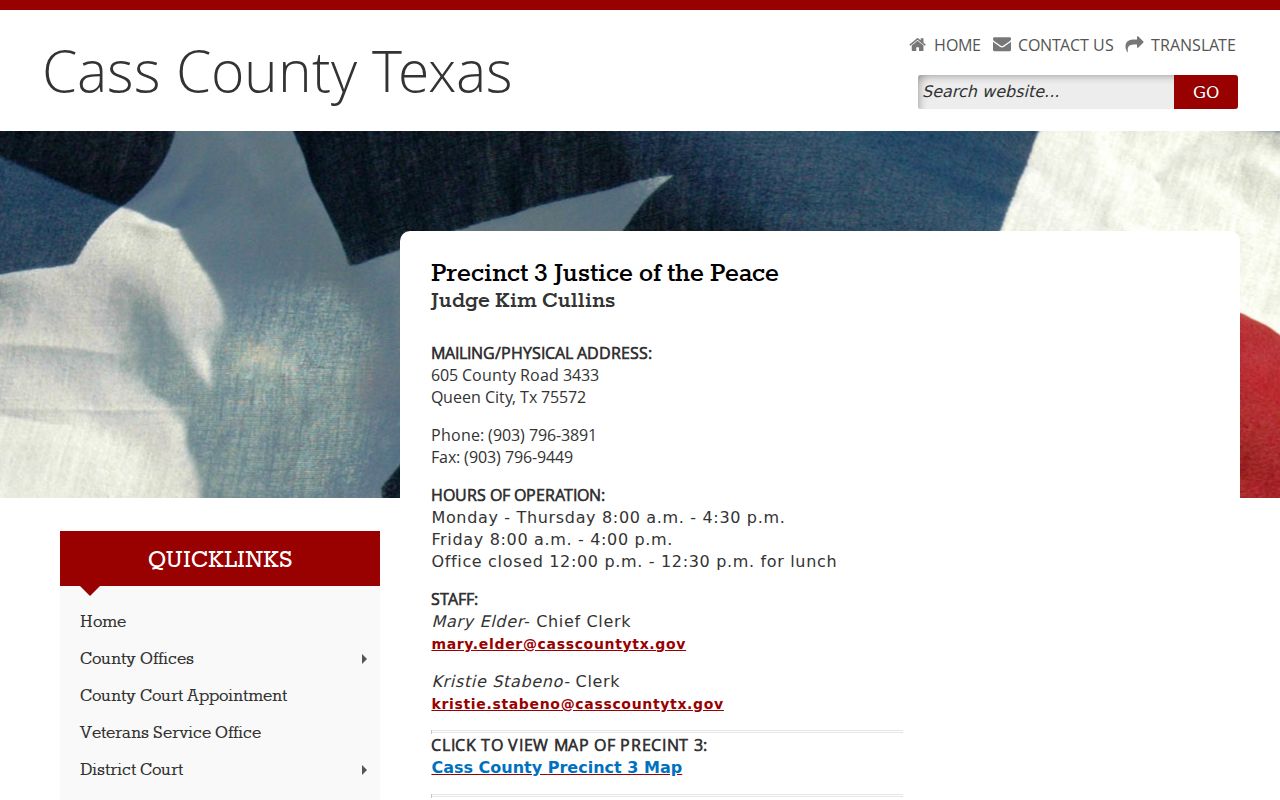
The court page is a contact and payment route, not a public bench-warrant result list.
Resolving a Cass County Bench Warrant
Call the issuing court before sending money or walking in. Ask whether it allows a reset, full payment, a cash or reinstatement bond, a hearing, an attorney appearance, or a walk-through. Cass County publishes no universal recall form, local bond schedule, or warrant window.
Payment is not automatic recall. Confirm that the court changed the process status and ask whether another hearing or setting remains.
- Give the clerk the citation or cause number and the court name.
- Ask whether the record shows an FTA, capias, capias pro fine, or arrest warrant.
- Confirm the permitted action, amount, payment method, and whether a hearing is needed.
- Ask when the record will update and retain the receipt or court order.
- If arrest is a concern, ask counsel and the court where and when to appear.
Cass County Bench Warrant Payment: JP2 Card Limits
JP2's published page adds a card restriction worth knowing. Cards are not processed during the last three business days of each month, and the court sits in Hughes Springs while handling its own JP and municipal-judge routes. Ask the clerk which Cass County court record the citation belongs to and what alternate payment option is allowed. JP2's official court page lists contact and payment details. Keep in mind the payment rules say nothing about whether a particular capias has been recalled; only the court record answers that.
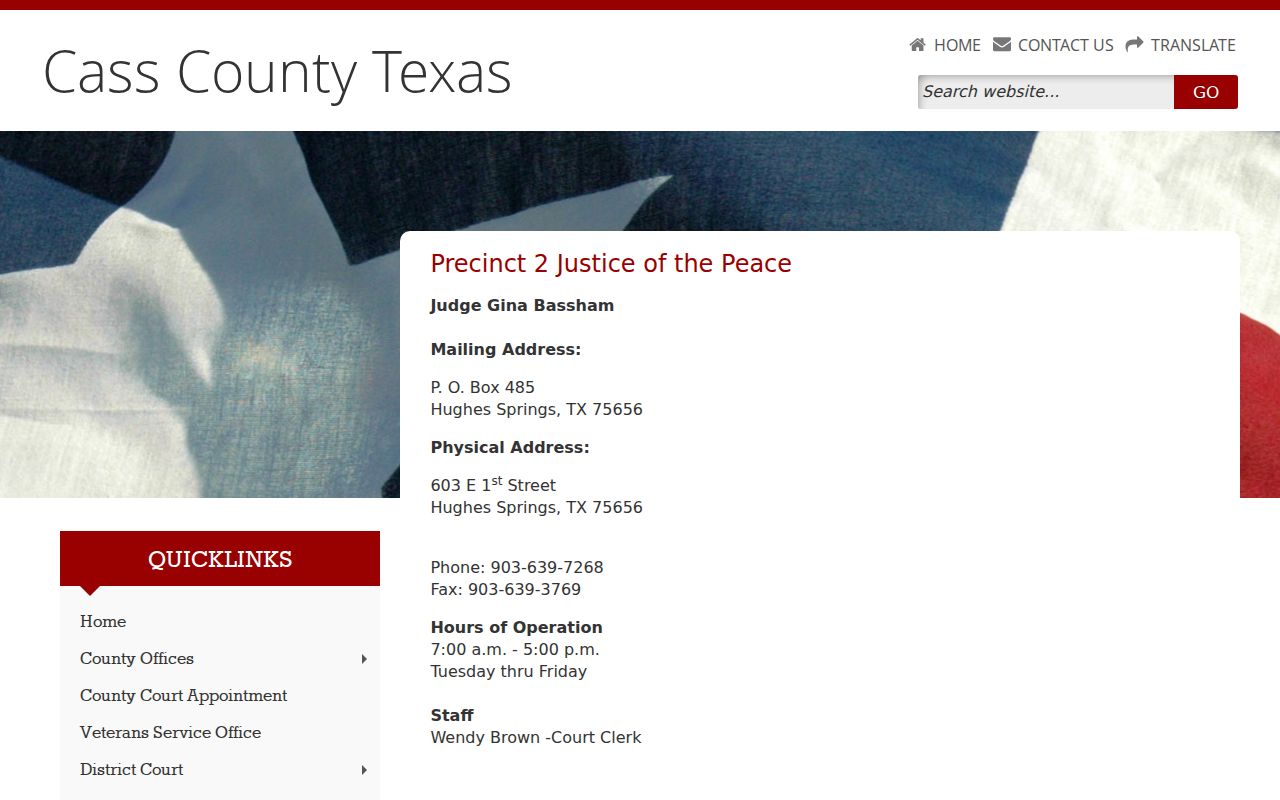
Confirm the month’s current payment options with JP2 before making a trip.
Cass County Bench Warrant Status and Magistrate Rotation
JP1's handout lays out how magistrate duty rotates across Cass County's four JPs. Coverage runs by week, starting Monday at 8 a.m. and lasting until the next Monday at 8 a.m., and the sheriff can confirm any schedule changes. This schedule matters when someone needs an initial appearance after arrest. It will not help you find which court owns an older case. JP1's information also describes typical magistrate hearings running 9 a.m. to 1 p.m., but call first before relying on any time. One more point: a duty rotation never moves citation or recall authority away from the original court. Read JP1's magistrate information for the stated rotation, then check with the sheriff on who is actually on duty.
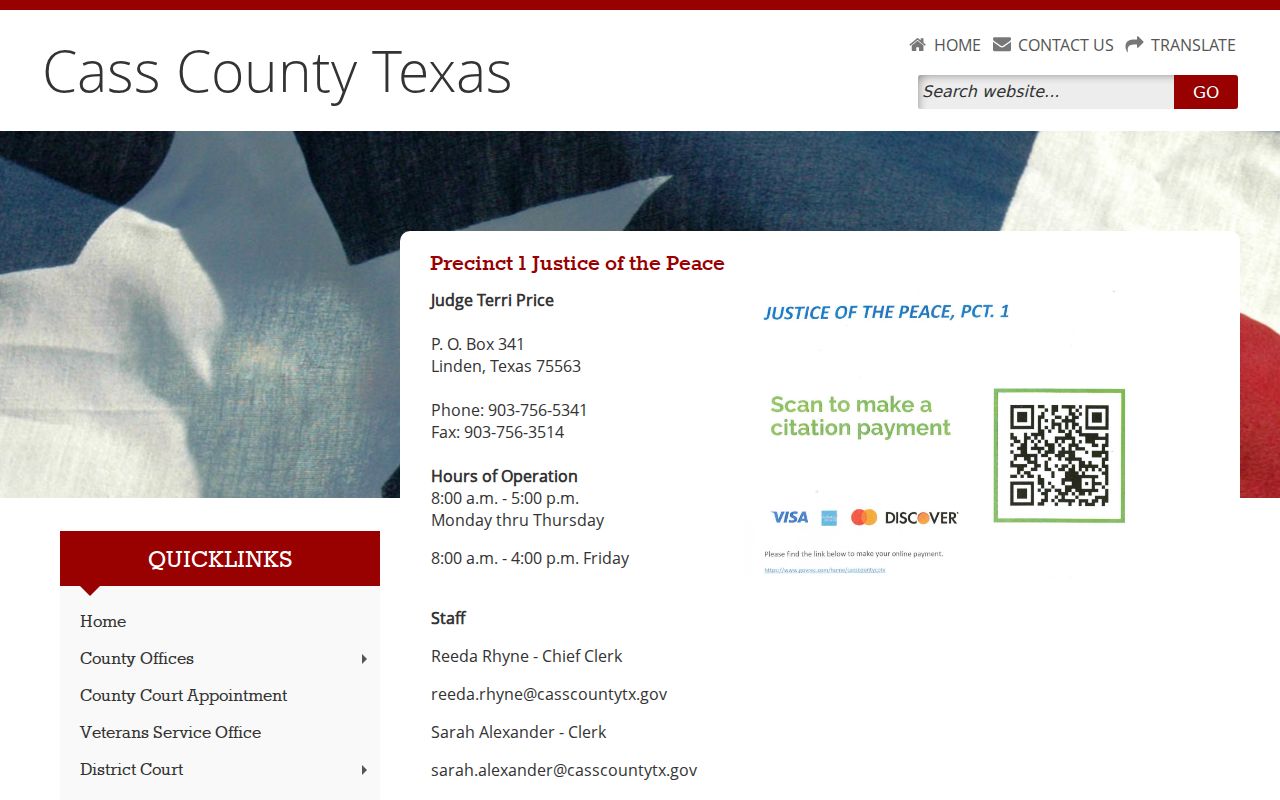
Use JP1's page as a Cass County schedule reference, then confirm who is on duty through the sheriff.
Finding the Court That Issued the Warrant
Finding the right office starts with the court named on the citation. For a felony or County Court at Law matter, call the District Clerk at 903-756-7514; the Fifth District Court line is 903-756-7515 extension 1, and County Court at Law is extension 2. The JP numbers are JP1 at 903-756-5341, JP2 at 903-639-7268, JP3 at 903-796-3891, and JP4 at 903-796-8493. Cities route differently across Cass County. Atlanta Municipal Court is 903-796-7153 ext. 116; Linden is 903-756-3734; Avinger is 903-562-1000; Bloomburg is 903-728-5323. Hughes Springs cases go through JP2, and Queen City cases go through JP3.
Cass County District Clerk
604 Highway 8 North, Linden, TX 75563
903-756-7514
Ask About Cass County Bench Warrant Fields
Cass County publishes no bench-warrant roster with labeled columns, so you cannot read a status legend online. Ask the clerk instead. The fields worth requesting are the citation or cause number, the process label, the issue date, and the missed setting or judgment behind it. Also ask for the balance or bond, the current status, and the next court date.
- FTA
- Failure to appear when a court date or order required attendance.
- Capias pro fine
- Process tied to an unsatisfied fine judgment, subject to Article 43.05.
- Recall
- The issuing court withdraws its process.
- Reset
- The court sets a new date; the underlying case may remain open.
For the full local chain of next steps, see what to do if you have a Cass County warrant.